European Accessibility Act: what it means for digital teams

Yamila FigueroaWebxya
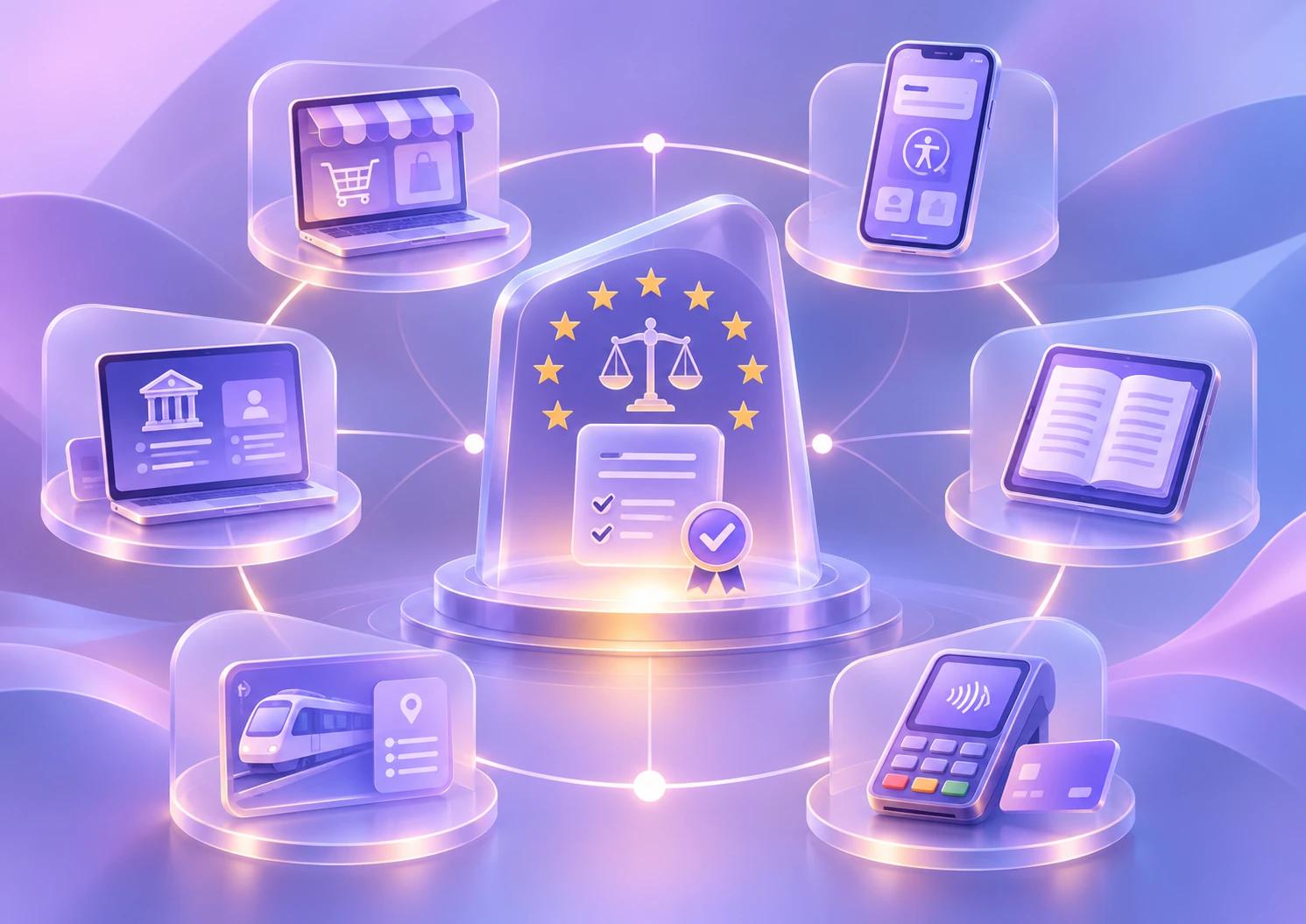
The EAA applies to specific products and services in the EU. Learn how scope, national rules and digital journeys shape accessibility obligations.
Introduction
The European Accessibility Act has changed the way many organizations operating in the European market need to think about digital accessibility.
Since 28 June 2025, the accessibility requirements introduced through Directive (EU) 2019/882 have applied to specific categories of products and services placed on the market or provided to consumers in the European Union. Those categories include areas such as e-commerce, consumer banking, e-books, electronic communications, certain passenger transport services, smartphones, computers, e-readers, payment terminals, and other self-service technologies.
That scope is significant, but it is also more specific than many summaries of the legislation suggest.
The European Accessibility Act does not mean that every private website in Europe automatically has exactly the same legal obligations. Nor does it mean that passing an automated accessibility test, reaching a particular Lighthouse score, or meeting a single technical checklist is enough to establish legal compliance.
For digital teams, the first question is more basic: does the product or service fall within the scope of the legislation that applies to the organization?
Only after answering that question does it become useful to examine the website, mobile application, checkout flow, customer support journey, digital documentation, authentication process, or other interfaces involved in delivering that service.
There is another complication. The European Accessibility Act is a Directive, which means Member States have transposed it into national legislation. Organizations therefore need to understand both the European framework and the national rules, enforcement mechanisms, competent authorities, transitional provisions, and remedies that apply to their circumstances.
This article provides general information about digital accessibility and the European Accessibility Act. It is not legal advice. Organizations should review the national legislation applicable to their circumstances and seek qualified legal advice where necessary.
What the European Accessibility Act is
The European Accessibility Act, commonly referred to as the EAA, is Directive (EU) 2019/882 on the accessibility requirements for products and services.
Its purpose is not simply to create another accessibility checklist. The Directive was designed to reduce differences between accessibility rules across EU Member States for selected products and services, while improving access for persons with disabilities.
That distinction matters.
The EAA establishes a common European framework, but its obligations are connected to particular categories of products and services rather than to the existence of a website alone. A website may be part of a covered service, but the website itself is not automatically the reason the organization falls within scope.
For example, an online store may fall within the rules because the Directive expressly covers e-commerce services. A passenger transport operator may have obligations affecting its website, mobile application, electronic ticketing, and digital travel information because those digital elements form part of a covered transport service. A consumer banking provider may have accessibility obligations across digital interfaces because consumer banking services are included in the Directive.
A corporate website that does not itself provide a service covered by the EAA presents a different scope question.
This is why organizations should resist beginning with “Is our website compliant with the EAA?” and start instead with “Which of our products and services are covered, and which digital touchpoints are necessary to provide them?”
The EAA has applied since 28 June 2025
Member States were required to transpose the Directive into national law, and the measures implementing its requirements began to apply from 28 June 2025.
For many organizations, that date shifted accessibility from something associated mainly with public-sector requirements, voluntary standards, procurement expectations, or general inclusive-design practice into a more direct regulatory consideration for certain consumer products and services.
The date should not, however, be interpreted as though every existing product and service suddenly became subject to an identical set of obligations without transitional provisions or distinctions.
The Directive contains specific rules about scope, products placed on the market, services provided to consumers, existing contracts, self-service terminals, and other transitional situations. National legislation may also determine enforcement processes, penalties, competent authorities, and procedural details.
For organizations evaluating exposure in 2026, the useful question is therefore not simply whether the deadline has passed. It has. The question is whether the relevant product or service is covered now, which national implementation applies, and whether any transition or exception is relevant to the specific case.
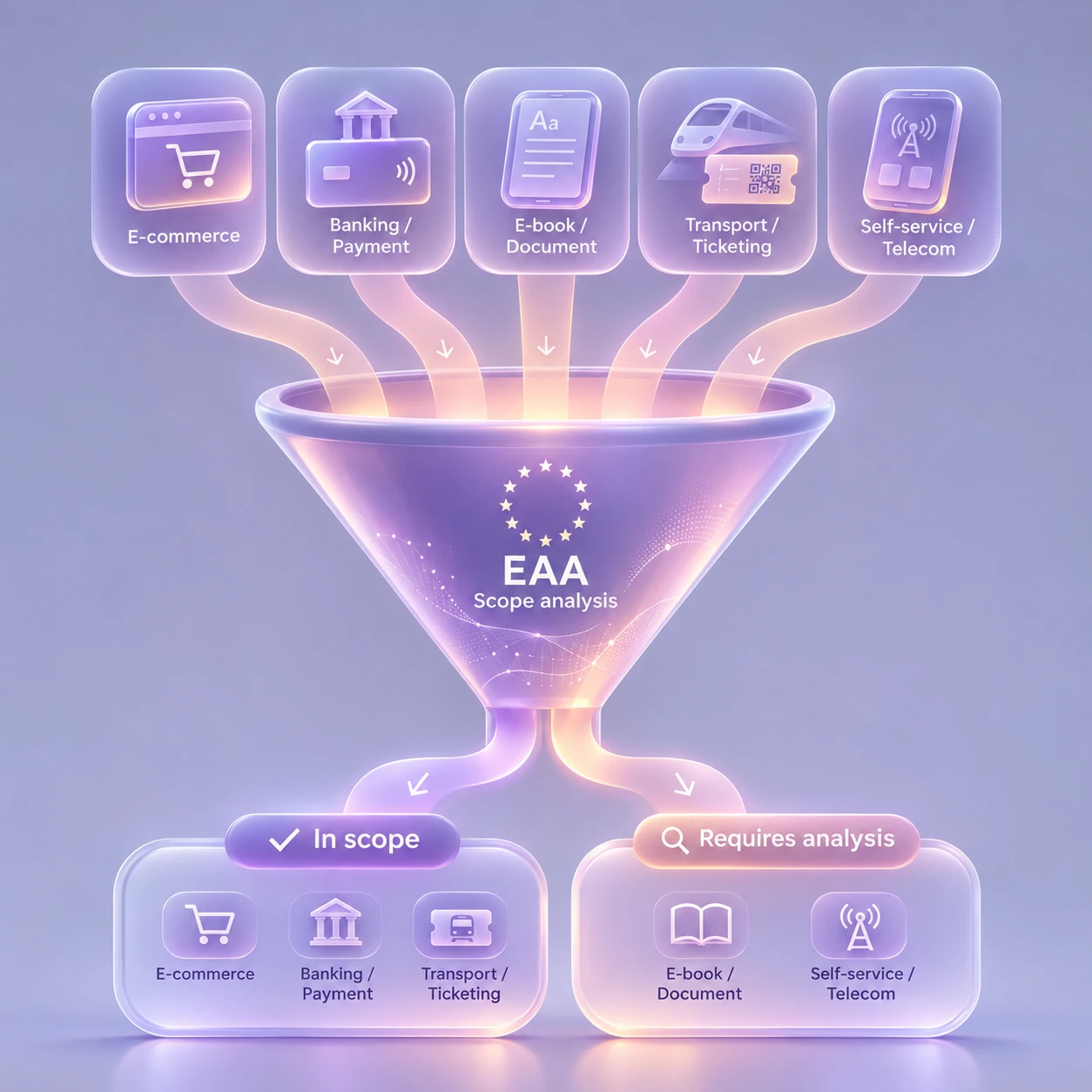
Which products and services are covered?
The EAA covers a defined group of products and services that EU legislators identified as particularly important for persons with disabilities and as areas where differing national accessibility rules could create barriers in the internal market.
Covered products include areas such as:
- consumer general-purpose computer hardware systems and their operating systems;
- payment terminals;
- certain ATMs, ticketing machines, check-in machines, and interactive self-service terminals;
- consumer terminal equipment used for electronic communications;
- consumer equipment used to access audiovisual media services;
- e-readers.
Covered services include:
- electronic communications services, subject to specified exclusions;
- services providing access to audiovisual media services;
- specified digital elements of air, bus, rail, and waterborne passenger transport services;
- consumer banking services;
- e-books and dedicated software;
- e-commerce services.
For a digital team, that list is more useful than a generic statement that “the EAA applies to websites.”
A company may operate several websites, apps, portals, and internal platforms, while only some of them are connected to a service within scope. Conversely, a single covered service may depend on many digital touchpoints that need to be considered together.
This scope analysis should happen before a team creates a remediation backlog.
What does this mean for websites and mobile experiences?
When a covered service is delivered through a website or mobile experience, accessibility cannot be treated as a separate layer added after the service has already been designed.
The Directive's accessibility requirements reach into the way information is provided and the way the service itself can be perceived, operated, understood, and used.
In practice, that can affect much more than visual presentation.
Digital teams may need to examine navigation, forms, authentication, error handling, customer information, instructions, payment flows, documentation, support content, and compatibility with assistive technologies. Mobile applications may require the same level of attention as websites when they are part of the covered service.
This also means that reviewing only the homepage is unlikely to tell an organization very much about the accessibility of a service.
A customer may begin on a landing page, move into an account area, complete a multi-step form, receive information by email, authenticate through another interface, make a payment through a third-party integration, and later contact support. If those steps are necessary to use a covered service, the accessibility conversation has to follow the journey rather than the organizational chart.
That is why accessibility assessments for regulatory risk need to examine complete user journeys and the systems supporting them, not simply isolated pages.
E-commerce deserves special attention
E-commerce is one of the areas where misunderstandings about the EAA are particularly consequential.
The Directive defines e-commerce services broadly around services provided at a distance through websites and mobile device-based services, by electronic means, at the individual request of a consumer, with a view to concluding a consumer contract.
That means the accessibility implications are not limited to online stores selling products that are themselves listed elsewhere in the Directive.
The e-commerce service is a covered category in its own right.
For many organizations, this brings the commercial journey into focus: product or service discovery, information needed to make a purchasing decision, account creation where required, shopping baskets, checkout, forms, payment-related interactions, confirmation, and other steps involved in concluding the consumer contract.
Accessibility failures at these points can be more serious than an isolated presentational issue elsewhere because they may prevent someone from completing the core purpose of the service.
Digital teams should therefore resist treating e-commerce accessibility as a collection of disconnected WCAG tickets. It is better understood as a service journey whose essential information and functionality need to remain accessible from discovery through transaction.
What the EAA does not mean
The EAA has generated a large amount of simplified guidance, and some of it turns useful principles into misleading absolutes.
It does not mean that every private website available in the European Union automatically has the same EAA obligations.
It does not mean that every organization operating in Europe is subject to identical requirements regardless of what it provides, its role in the supply chain, or whether an exception applies.
It does not mean that an automated accessibility scanner can determine legal compliance.
And it does not mean that “WCAG compliant” is a complete legal conclusion.
Technical accessibility standards are extremely important, but regulation involves questions of scope, economic-operator responsibilities, service requirements, national transposition, evidence, enforcement, exceptions, and sometimes sector-specific obligations. A technical audit can provide evidence about barriers. It cannot, by itself, answer every legal question.
This distinction is similar to the one we explored in Accessibility Is More Than a Lighthouse Score. Automated tools are useful evidence. They are not a substitute for understanding how people interact with a product or for evaluating the regulatory framework that applies to it.
Exceptions and proportionality
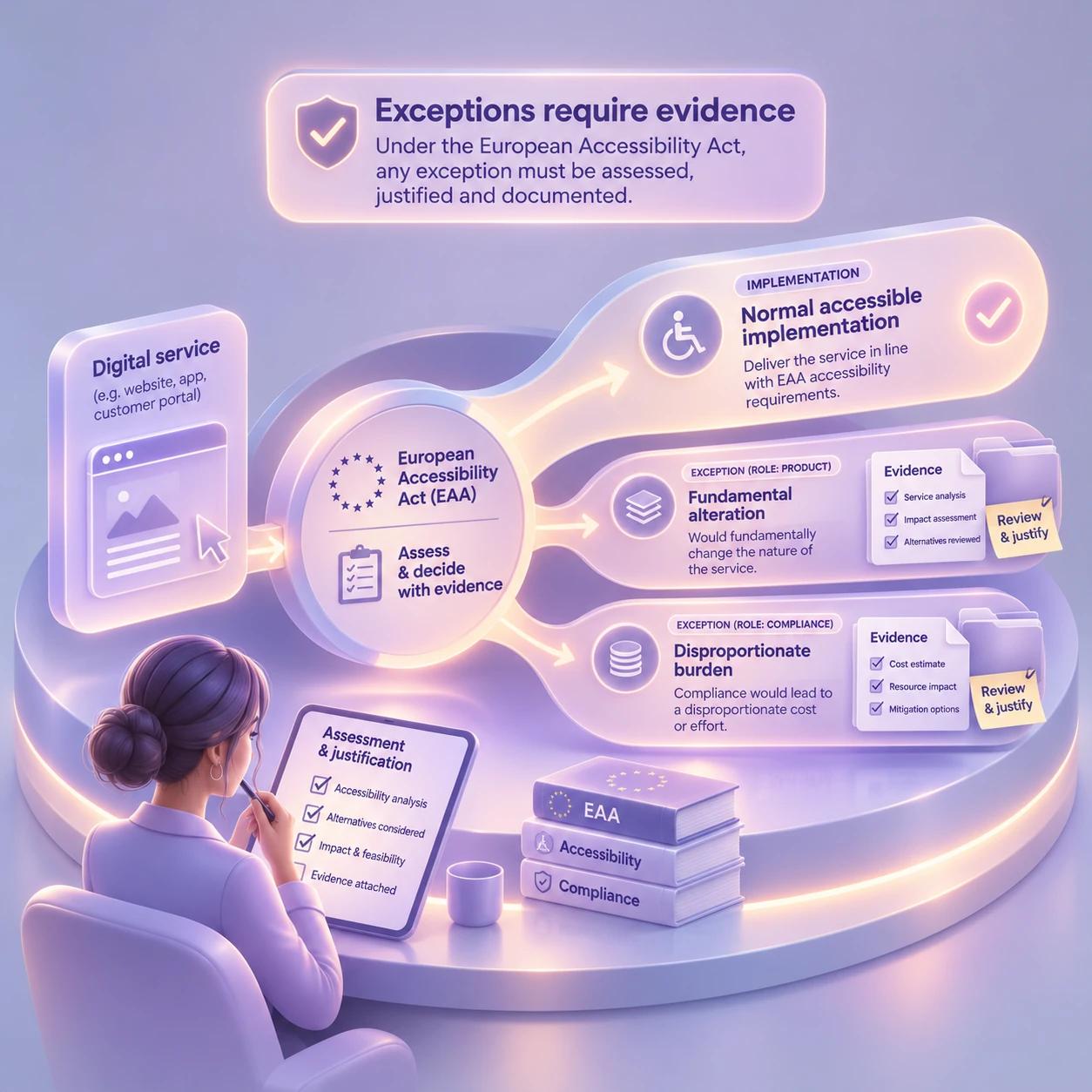
The Directive includes mechanisms designed to account for circumstances in which applying particular accessibility requirements would create a fundamental alteration of a product or service or impose a disproportionate burden.
These provisions should not be understood as a general permission to postpone accessibility because remediation is inconvenient.
They involve specific conditions and assessments.
Microenterprises providing services
The Directive exempts microenterprises providing services from its accessibility requirements and obligations.
Under the Directive, a microenterprise is an enterprise employing fewer than 10 people and having an annual turnover not exceeding EUR 2 million or an annual balance-sheet total not exceeding EUR 2 million.
That service-provider exemption is important, but it should not be generalized to every small business scenario. The Directive treats microenterprises dealing with products differently, and other legislation may still create accessibility obligations or expectations.
An organization should therefore determine which role it is performing and which rules apply rather than assuming that being “small” automatically resolves the question.
Fundamental alteration
Accessibility requirements apply only to the extent that compliance does not require a significant change that would result in a fundamental alteration of the basic nature of the product or service.
This is a much narrower idea than “the change would require redesign work.”
Digital products evolve constantly. Components are replaced, interfaces are redesigned, systems are migrated, and customer journeys are changed for many reasons. The fact that accessibility requires technical or design effort does not in itself establish that the basic nature of a service would be fundamentally altered.
Organizations relying on this provision need to examine the actual effect of the accessibility requirement in the context of the product or service.
Disproportionate burden
The Directive also limits accessibility requirements where compliance would impose a disproportionate burden on the economic operator concerned.
Again, this is not simply another way to say that accessibility has a cost.
The Directive provides criteria for assessing disproportionate burden and requires economic operators, subject to specified exceptions, to assess and document the basis for relying on it. Service providers relying on disproportionate burden must also renew their assessment in specified circumstances and, in any event, at least every five years.
The practical lesson for digital teams is simple: proportionality should be treated as a documented legal assessment, not as an informal product-management decision.
EAA, WCAG and EN 301 549 are related but not identical
For digital teams, this is one of the most important distinctions in the entire discussion.
WCAG, EN 301 549, and the European Accessibility Act are related, but they are not interchangeable.
The European Accessibility Act is legislation. It establishes accessibility requirements for products and services within its scope and is implemented through national law.
WCAG, the Web Content Accessibility Guidelines published by W3C, is a technical accessibility standard focused on web content. It gives teams a mature framework for evaluating many of the barriers people encounter in digital interfaces.
EN 301 549 is a European standard containing accessibility requirements for information and communication technologies. Its scope extends beyond websites and includes requirements for areas such as software, hardware, documentation, support services, and other ICT contexts.
EN 301 549 has historically drawn heavily from WCAG for web requirements, but it also contains requirements that are not part of WCAG.
The European Commission has also instructed European standardisation organisations to update accessibility standards, including ICT standards, so that they address the requirements of the European Accessibility Act.
This evolving standardisation environment is another reason organizations should be cautious about simple claims such as “EAA compliance equals WCAG 2.2 AA.”
WCAG remains extremely useful for digital accessibility work, and teams should not wait for legal interpretation before applying good accessibility practices. But technical conformance and legal compliance are different questions.
If your team needs a practical introduction to the technical framework, WCAG Explained Without the Technical Jargon provides the foundation without treating WCAG as the entirety of accessibility.
What organizations should do now
For an organization that sells products or provides services in the European market, a sensible response starts with scope rather than panic.
First, identify the products and services offered to consumers in the EU and determine whether any fall within the categories covered by the EAA. This is the point where legal expertise may be necessary, particularly for complex business models, cross-border services, intermediaries, or organizations operating through several legal entities.
Second, identify the national legislation that applies. The EAA created a European framework, but Member States implement and enforce it through national law.
Third, map the digital journey involved in providing each potentially covered service. Include websites, mobile applications, account areas, checkout, authentication, digital documentation, customer communications, support flows, and relevant third-party services.
Fourth, establish an accessibility baseline. Automated testing can help identify certain technical failures quickly, but it should be combined with manual evaluation of keyboard interaction, focus management, forms, structure, assistive-technology compatibility, content, and critical user journeys.
Fifth, distinguish isolated defects from systemic sources. An inaccessible component used hundreds of times deserves a different remediation strategy from a one-off content error.
Sixth, integrate accessibility into design, development, content, procurement, quality assurance, and release processes. A one-time remediation project may improve the current product while leaving the system that created the barriers untouched.
Finally, maintain evidence. Accessibility statements, testing records, component documentation, procurement requirements, remediation decisions, and assessments relating to exceptions may all become part of the organization's broader compliance and governance picture.
A useful internal view can look like this:
| Question | What the organization needs to establish |
|---|---|
| Are we in scope? | Which products or consumer services fall within the EAA and applicable national law |
| What digital experiences are involved? | Websites, apps, checkout, authentication, documents, support, third parties |
| Where are the barriers? | Evidence from technical testing and real user journeys |
| What should be fixed first? | Critical and recurring barriers with the greatest impact |
| What prevents recurrence? | Components, standards, procurement, QA, ownership, governance |
| What needs legal review? | Scope, national requirements, exceptions, evidence, enforcement exposure |

Accessibility should not begin with a legal deadline
Regulation can create urgency, and sometimes that urgency is useful.
A legal requirement can unlock budget, move accessibility higher in a roadmap, or make responsibilities clearer. It can also prompt organizations to examine products that have accumulated barriers for years.
But the strongest accessibility strategy does not begin and end with compliance.
People encounter inaccessible forms, navigation, authentication, documents, checkout flows, and customer support regardless of whether a regulator has examined them. Those barriers affect product quality before they become legal risk.
The Business Case for Digital Accessibility is therefore broader than the EAA. Accessibility can reduce remediation, strengthen reusable systems, improve product quality, reduce operational friction, and make digital services usable by more people.
Regulation adds another reason to act. It does not replace the others.
The same is true of technical standards. WCAG will continue to evolve, but future standards should not become an excuse to postpone accessibility work that can be done today.
For organizations operating in the EU, the practical sequence is clear: understand scope, obtain legal guidance where needed, examine the complete digital service, identify actual barriers, and build accessibility into the systems that produce future work.
If your digital product operates in the European market and you need to understand its accessibility barriers, an accessibility assessment can establish where the experience currently fails and which patterns should be addressed first. Questions about the legal interpretation of the EAA, national legislation, exemptions, or enforcement should be reviewed with qualified legal counsel.
This article is provided for general informational purposes only and does not constitute legal advice.
Keep reading

NGOs do not need to solve every accessibility issue at once. Start with critical services, set a baseline, stop creating new barriers and build a roadmap.

Accessibility
Accessibility debt: the problem nobody talks about
Accessibility debt builds up when an inaccessible decision repeats across components, content, code and processes. The longer it spreads, the more it costs.
If these challenges sound familiar, let’s talk about your context.
Start a conversation